Research the margin the market is asking a team to cover.
PropMine connects a point spread to against-the-spread history, favorite and underdog roles, team and matchup context, venue, conditions, expected game environment, and the exact line being evaluated.
What this research workflow includes
Current spread first
Confirm the exact favorite, underdog, margin, price, sportsbook, and timestamp before applying any historical ATS result.
Against-the-spread records
Inspect the lines and games behind an ATS summary so covers at materially different margins are not treated as identical evidence.
Favorite and underdog roles
Compare how a team performs in the same market role while accounting for opponent quality, line range, venue, personnel, and sample size.
Home and road context
Use the location relevant to today's matchup and examine whether travel, venue, surface, or crowd environment changes the comparison.
Matchup and game script
Connect the required margin to pace, scoring distribution, style, depth, late-game behavior, and the matchup variables that affect separation.
Line movement
Treat a move from one spread to another as a change in the question. Recheck the historical and matchup case at the number currently available.
See the research workflow
What a point spread changes
A moneyline asks only which side wins. A point spread asks whether the favorite wins by more than the assigned margin or the underdog stays within it. That makes margin distribution, scoring environment, pace, late-game behavior, and the exact number central to the research process.
An ATS record summarizes past outcomes relative to the closing or recorded line used by the source. It does not show that a team is inherently good or bad against every future spread. A cover at -2.5 does not prove the same team should cover -8.5, and a push or price difference can change the decision even when the matchup is unchanged.
How to interpret ATS and favorite/dog trends
Start by checking the actual spreads in the qualifying games. Then compare opponent strength, home and road location, favorite or underdog role, injuries, starting personnel, rest, and whether the team's style produces close games or wider margins. Small samples and wide line ranges should reduce confidence in a simple ATS percentage.
A correlated matchup can make the category worth investigating—for example, a strong home favorite facing a weak road underdog—but the same games may also drive the teams' overall and location records. Do not count overlapping trends as separate proof, and do not assume a visually extreme record creates value at today's number.
How PropMine supports spread research
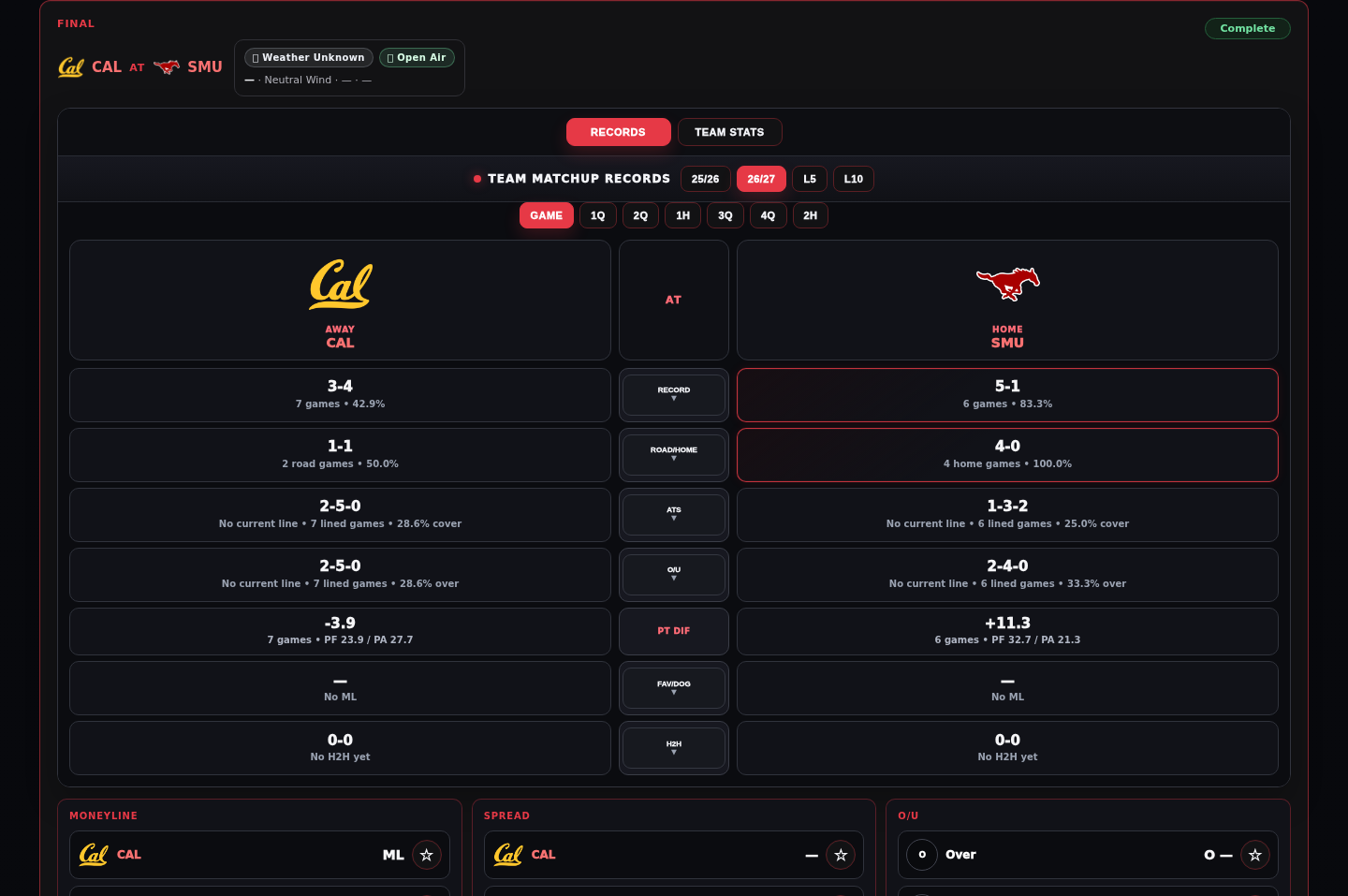
Today's Games organizes active events, current lines, team records, favorite and underdog context, venue, weather, and category filters. Team Labs and Matchup Labs add personnel, form, opponent comparison, and sport-specific evidence. Supported event controls can narrow a large slate from a category to the selected game.
PropMine's outlier treatments are designed to prioritize research without adding a pick label. A one-team outlier and a two-team alignment can be visually distinguished where the rules support it, but the highlight remains descriptive. The user can inspect the current line and supporting context before deciding whether the pattern matters.
A repeatable spread workflow
Confirm the current spread and price, then review the teams' overall, location, favorite or underdog, and ATS samples. Identify the games and line ranges behind those records. Add the matchup, expected availability, pace or script, venue, conditions, and any sport-specific factors that affect margin rather than merely win probability.
Finally, test a countercase and recheck the line. If the number moved, the historical question changed. PropMine supports analysis of the evidence and market context; it does not guarantee that a team will cover or that a strong past ATS record will continue.
A repeatable research process
Find the market
Start with a verified current line or prop family. Keep sportsbook prices, pick’em lines, model output, and historical statistics clearly labeled.
Inspect the evidence
Review the player, role, matchup, team, game, and sport-specific variables behind the summarized rate. Check the time window and sample size.
Make the decision
Use the evidence to decide whether the line deserves attention. PropMine supports the process; it does not guarantee the result.
Research the line inside PropMine.
Move from the public methodology into the current PropMine research tools and follow the evidence across markets, players, teams, matchups, games, and sport-specific context.
Related PropMine research
Frequently asked questions
What is ATS in sports betting?
ATS means against the spread. It records whether a team covered the applicable point spread, not simply whether the team won the game.
Is a strong ATS record predictive?
Not by itself. The lines, opponents, locations, personnel, sample size, and current matchup determine whether the historical record is comparable.
Why does the exact spread matter?
Changing the margin changes what the team must accomplish. Results at one line cannot be applied automatically to a materially different number.
Does PropMine highlight spread outliers?
Supported Today's Games views can visually prioritize notable one-team or aligned matchup categories while keeping the highlight descriptive rather than calling it a pick.
Are point spreads and MLB run lines the same?
They are both margin markets, but baseball run lines have distinct pricing and game-structure considerations. PropMine documents them separately.
PropMine is independent research and decision-support software. It is not a sportsbook, does not accept wagers, and does not guarantee outcomes. Historical results do not guarantee future performance.