Research a pick'em projection without confusing it for sportsbook odds.
PropMine connects source-labeled pick'em lines to player history, role, opportunity, opponent, game environment, teammate context, and alternate thresholds while keeping projections separate from sportsbook markets.
What this research workflow includes
Source-labeled lines
Identify the pick'em source, player, event, market, side, threshold, and timestamp before using any historical result.
Higher and lower research
Evaluate the same player opportunity from both directions instead of treating a recent higher rate as the only relevant case.
Exact threshold comparison
Use the line actually posted and compare nearby alternate thresholds rather than applying one historical rate to every projection.
Role and opportunity
Inspect minutes, usage, attempts, routes, touches, shots, lineup status, teammates, or other sport-specific opportunity evidence.
Opponent and game context
Connect the player to the matchup, team environment, venue, conditions, expected script, pace, or other factors relevant to the market.
Sportsbook separation
Do not interpret a pick'em projection as if it carries the same price and implied probability as a sportsbook prop with American odds.
See the research workflow
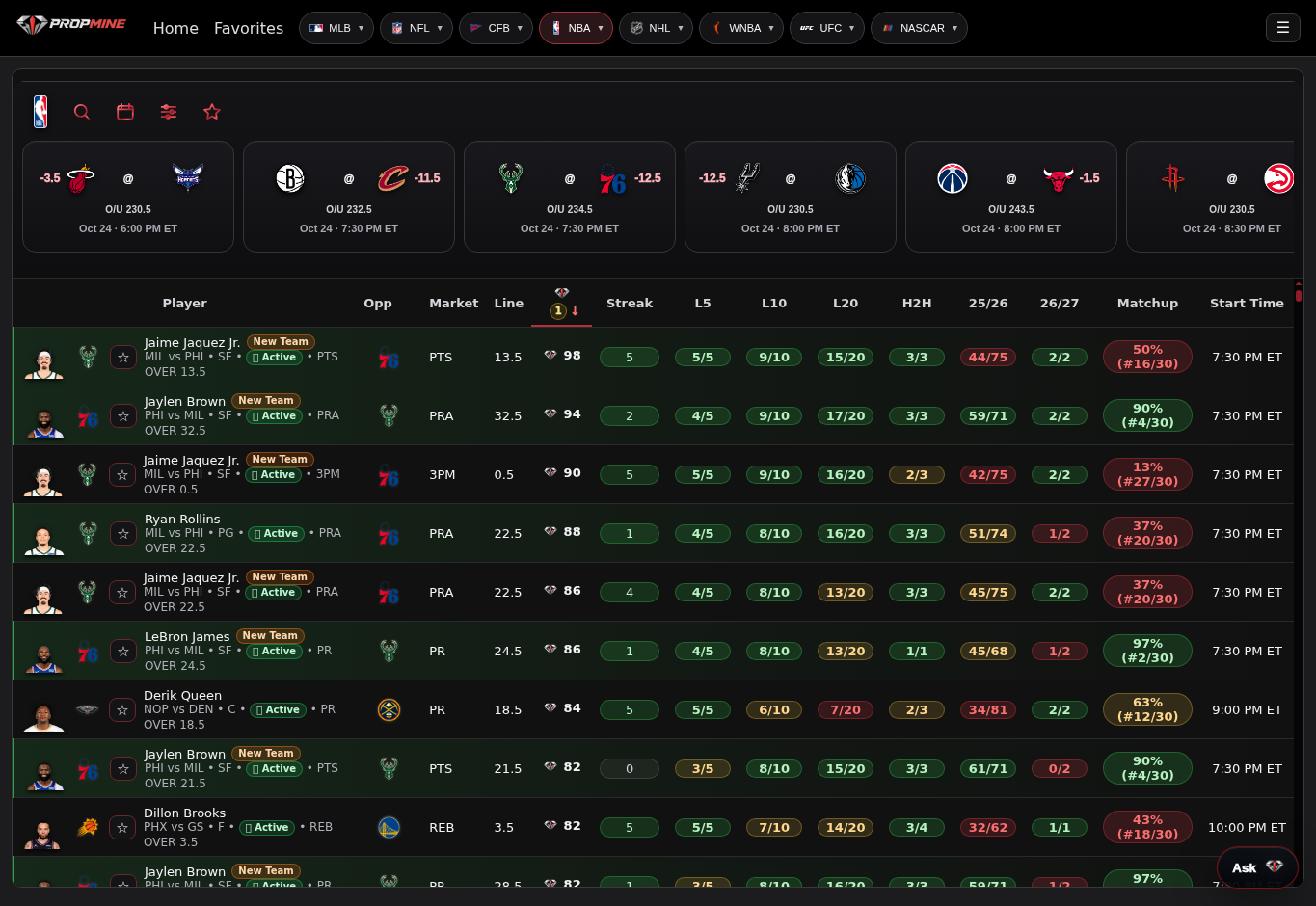
Pick'em projections and sportsbook props are different products
A pick'em line commonly presents a player projection and asks the user to choose higher or lower within the platform's entry rules. A sportsbook player prop presents a line together with odds for each side. The same numerical threshold can therefore represent different prices, payouts, constraints, and break-even requirements.
PropMine labels sportsbook and pick'em sources separately so historical performance does not erase the market structure. A player going higher than a threshold in six of ten games is still only a description of those games. It does not determine the effective price of an entry or prove that either side is favorable under the source's current rules.
Research the exact player and threshold
Confirm player identity, team, opponent, date, market family, projection, and source. Compare recent and longer windows at the exact threshold, then open the games behind the rate. Determine whether the player's role, minutes, opportunities, lineup position, or teammates changed enough to make older games less comparable.
Use Prop Ladders or alternate-threshold context where supported to understand how quickly the historical result changes around the posted line. A strong rate at a lower threshold may disappear one unit higher. That sensitivity matters when different pick'em sources post slightly different projections for the same player and market.
Connect the player to the game
Player outcomes depend on more than the recent log. Add opponent strengths and weaknesses, likely game script, team totals or environment, pace, venue, weather, lineup and injury context, and the sport-specific evidence that affects opportunity or efficiency. Teammate-aware samples can help where verified participation supports them.
PropMine's Big Boards lead into Player Labs, Team Labs, Matchup Labs, Today's Games, Prop Ladders, custom research, and Ask PropMine. The workflow is designed to keep the selected source and threshold attached while the user investigates why the historical sample may or may not apply today.
A repeatable pick'em research workflow
Start with the source-labeled projection. Inspect higher and lower cases, the exact games, sample size, role stability, matchup, and game environment. Compare nearby thresholds and identify what current news could invalidate the sample. Review the source's current entry and payout rules directly because those rules are not interchangeable with sportsbook odds.
Do not combine lines from different sources without preserving their identity and timestamp. PropMine does not invent unavailable projections and does not treat a stale line as current. It provides research and decision support, not a promise of successful pick'em results or an assurance that any entry will be profitable.
A repeatable research process
Find the market
Start with a verified current line or prop family. Keep sportsbook prices, pick’em lines, model output, and historical statistics clearly labeled.
Inspect the evidence
Review the player, role, matchup, team, game, and sport-specific variables behind the summarized rate. Check the time window and sample size.
Make the decision
Use the evidence to decide whether the line deserves attention. PropMine supports the process; it does not guarantee the result.
Research the line inside PropMine.
Move from the public methodology into the current PropMine research tools and follow the evidence across markets, players, teams, matchups, games, and sport-specific context.
Related PropMine research
Frequently asked questions
What is a pick'em player-prop line?
It is a player projection offered by a pick'em platform, commonly researched as a higher-or-lower decision under that platform's current entry rules.
Is a pick'em line the same as a sportsbook prop?
No. Sportsbook props include odds for each side. Pick'em lines use a different entry and payout structure, so the threshold alone does not make the markets equivalent.
Why does the exact threshold matter?
Historical results can change materially at nearby lines. Research should use the currently posted projection rather than a convenient lower or higher threshold.
Does PropMine combine pick'em and sportsbook data?
PropMine can organize both types of market research but labels the sources separately so a projection is not misrepresented as sportsbook odds.
Can PropMine guarantee a higher or lower result?
No. PropMine supports research into the player, threshold, role, matchup, and game context. It cannot guarantee a future outcome or profit.
PropMine is independent research and decision-support software. It is not a sportsbook, does not accept wagers, and does not guarantee outcomes. Historical results do not guarantee future performance.