Player prop trends are useful only when the sample remains inspectable.
PropMine connects player prop hit rates to the games, lines, roles, teammates, opponents, and conditions that produced them. The goal is to understand the sample—not mistake a recent percentage for a prediction.
What this research workflow includes
Current line first
Begin with the active market and its source label before interpreting any historical result. A hit rate without the current threshold does not answer the betting question.
Recent and longer windows
Compare supported recent, season, and longer samples rather than choosing one window because it produces the most attractive percentage.
Inspectable game logs
Open the qualifying games, dates, opponents, results, and role context behind the summary so the sample can be verified.
Alternate thresholds
Compare how the same player performed at nearby lines. A trend at one threshold should not be silently applied to a different market.
Role and teammate context
Evaluate minutes, usage, lineup role, participation, and supported With and W/O conditions when those factors materially change opportunity.
Opponent and game context
Connect the player sample to matchup, team, venue, weather, pace, expected script, or other sport-specific evidence where it applies.
See the research workflow
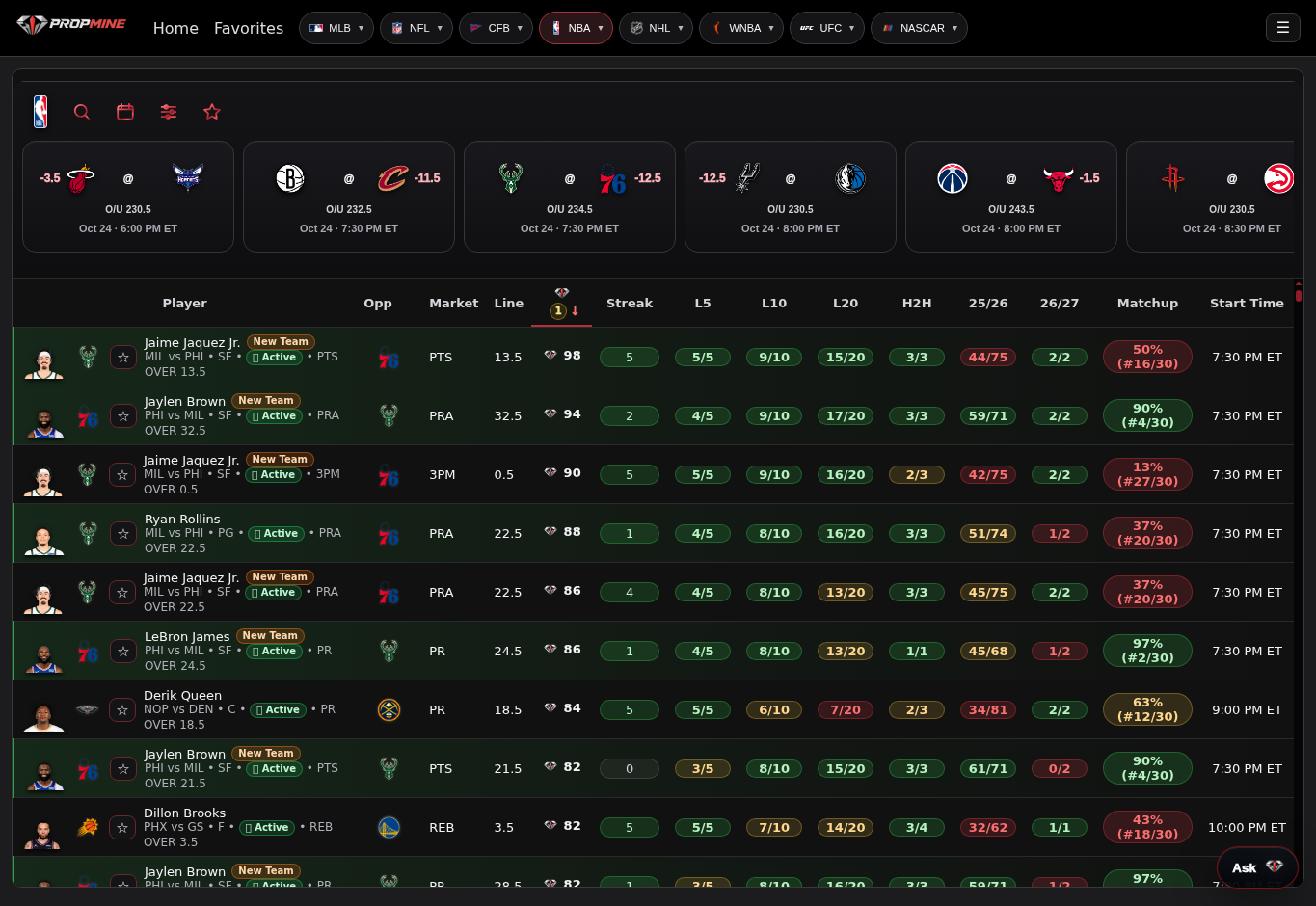
What a player prop trend actually means
A player prop trend summarizes what happened in a defined set of past games at a defined threshold. Player prop stats provide the underlying results, volume, role, and opponent evidence needed to interpret that summary. The useful question is not simply whether the player went over or under. It is which games qualified, whether the market line is comparable, what role the player held, and whether the current matchup resembles the historical sample.
PropMine treats the percentage as an entry point. The connected game log, chart, splits, role, teammate, opponent, and alternate-line evidence explain what the rate contains and what it leaves out.
Why a hit rate can mislead
A high recent hit rate can be driven by an unusually low threshold, overtime, temporary injuries, a short-lived lineup role, favorable opponents, or a sample too small to support a broad conclusion. A lower rate can also hide a recent role change or a materially different current line.
That is why PropMine keeps the denominator, exact games, line movement, sample window, and supporting context visible. Historical hit rates describe past outcomes; they are not a calibrated probability and do not guarantee the next result.
Trend research changes by sport
Basketball trends often require minutes, usage, lineup, teammate, shot, and pace context. Football adds depth-chart role, routes or opportunities, red-zone usage, game script, venue, and weather. Hockey adds line assignment, power-play role, shot volume, goalie workload, and expected game environment.
Baseball requires pitcher, batter, park, weather, lineup, and handedness context. Event-based sports use the course, fight card, track, field, or race environment appropriate to the market rather than forcing every trend into one generic template.
A practical player prop trend workflow
Start with the current market and verify the player, game, prop family, line, and source. Compare more than one time window, then open the game log and identify whether the qualifying results came from a stable role. Test nearby thresholds and inspect the current opponent and game environment before deciding whether the trend is relevant.
If a filter produces only a few games, treat the result as a narrow observation. PropMine is designed to make that limitation visible rather than converting a small sample into an inflated claim.
A repeatable research process
Find the market
Start with a verified current line or prop family. Keep sportsbook prices, pick’em lines, model output, and historical statistics clearly labeled.
Inspect the evidence
Review the player, role, matchup, team, game, and sport-specific variables behind the summarized rate. Check the time window and sample size.
Make the decision
Use the evidence to decide whether the line deserves attention. PropMine supports the process; it does not guarantee the result.
Start with the trend, then inspect the games behind it.
PropMine keeps current lines, historical results, game logs, alternate thresholds, and supporting context connected so a summarized hit rate can be evaluated instead of accepted at face value.
Related PropMine research
Frequently asked questions
What is a player prop trend or player prop stats tool?
It summarizes historical outcomes at a selected line or condition and should let the user inspect the games, sample size, role, matchup, and other player prop stats behind the rate.
Are player prop hit rates predictions?
No. Hit rates describe a historical sample. They are not a guaranteed outcome or a calibrated probability for the next game.
Can I research today's player prop trends in PropMine?
Yes, when verified current markets are available. PropMine connects the active line to historical results and the supporting player, team, matchup, and game context.
Which sample size should I use?
There is no universal best window. Compare recent and longer samples, inspect the qualifying games, and determine whether the player's role and the current line are comparable.
Does PropMine show the games behind a trend?
Yes. The research workflow is built around inspectable charts, game logs, splits, role evidence, and connected context rather than a percentage alone.
PropMine is independent research and decision-support software. It is not a sportsbook, does not accept wagers, and does not guarantee outcomes. Historical results do not guarantee future performance.